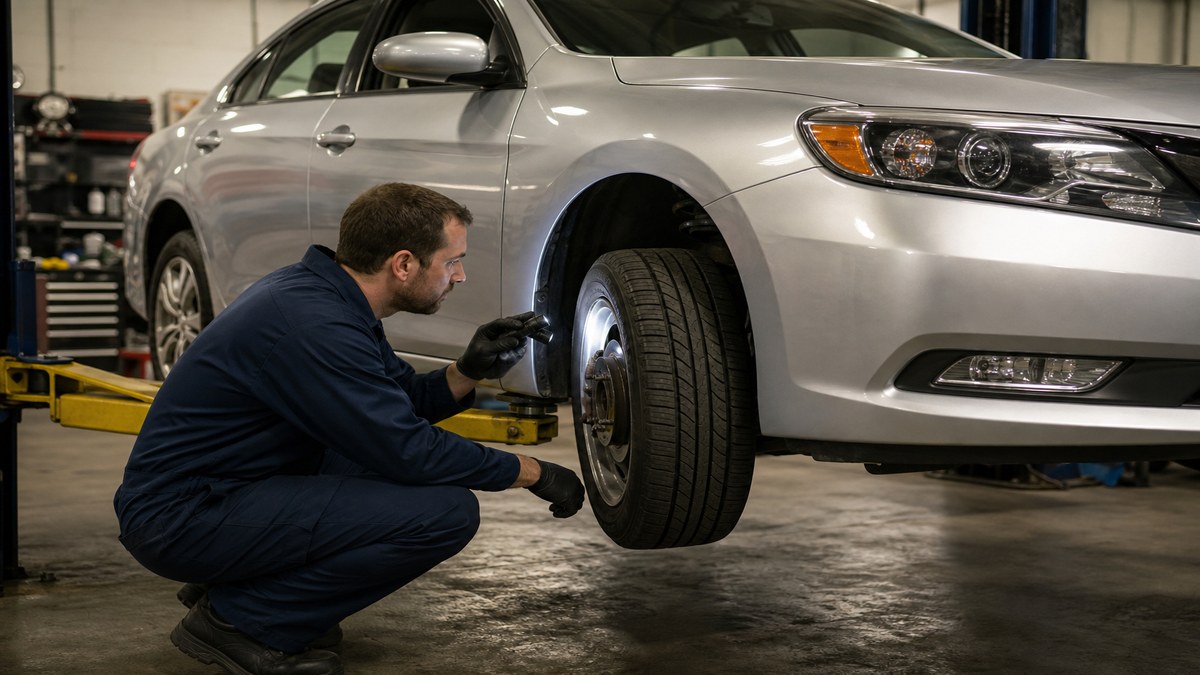
Your car doesn't fail the Uber inspection because it's a bad car. It fails because of one line on a 19-point form — usually tires or brakes — and the form is pass/fail on every single line. One "fail" and the whole sheet is dead. You go home, fix it, pay for a second inspection, and lose another day of earning.
That's the part nobody explains up front. So here's what actually gets checked, what actually fails, and how to walk in already knowing you'll pass.
Uber's vehicle inspection form runs about 19 checkpoints. Brakes. Tires. Lights. Steering and suspension. Glass, wipers, mirrors. Seat belts. Horn. Each one gets marked pass or fail by a certified mechanic. Every point must pass — there's no "mostly good enough." A single fail means the car isn't approved until you fix it and get re-inspected.
The inspection itself is cheap and fast. Most shops charge $20 to $40 and take under 30 minutes. The completed form is good for 12 months, and once you upload it to the Driver app the review usually clears within 24 hours.
The cost isn't the inspection. The cost is the failure — a second appointment, a repair bill, and days you're not driving.
Worn tires are the single most common failure. Not "bald" — just worn past the threshold. Take a penny, stick Lincoln's head down into the tread groove. If you can see the top of his head, that tire is at or below 2/32" and it's failing. Do this on all four, in three spots each (inside, center, outside), because uneven wear from bad alignment will fail one edge while the center still looks fine.
Four decent tires run $400–$700 installed on a common sedan. Painful, but you were going to need them anyway.
Second most common. Mechanics check pad and shoe thickness, plus the parking brake. If your brakes squeal, grind, or the pedal goes soft, you already know the answer. Pads on a Camry or Accord are typically $150–$300 per axle. Rotors, if they're scored, push that toward $400–$600.
This one is infuriating because it's a $3 bulb. Headlights, tail lights, brake lights, turn signals, reverse lights, plates lights. Walk around the car with someone pressing the pedal. Most drivers never check their own brake lights, you can't see them from the driver's seat.
A chip or crack in the driver's sightline fails. Off to the corner, usually fine. Most insurance policies with comprehensive coverage will fill a chip for zero deductible, and it takes 20 minutes. Waiting turns a $0 fill into a $300–$500 windshield replacement once it spiders out.
Torn rubber, chattering, streaking, that's a fail on the glass and visibility section. Twenty-five dollars at any auto parts store, and most of them will clip the new blades on for you in the parking lot.
The expensive one. Worn tie rods, ball joints, or bushings mean excessive play in the steering, and that's a fail. The tell: clunking over bumps, wandering on the highway, or a steering wheel that isn't centered when you're driving straight. This is the failure that costs $500–$1,200 and takes the car off the road for days.
| Check | Takes | Costs if it's bad |
|---|---|---|
| Penny test, all 4 tires, 3 spots each | 3 min | $400–$700 |
| Brake pedal feel + listen for grind | 1 min | $150–$600 |
| Walk-around with all lights on, someone on the pedal | 4 min | $3–$40 |
| Windshield chip in the sightline? | 1 min | $0 with comp coverage |
| Run wipers on a wet windshield | 1 min | $25 |
| Wiggle steering wheel at rest, listen for clunks on a test drive | 5 min | $500–$1,200 |
| Every seat belt latches and retracts | 2 min | Varies |
| Horn works | 5 sec | $50–$150 |
Fifteen minutes of self-checks. That's the whole trick.
A clean inspection form doesn't automatically get you online. You also need the car to meet the platform's separate requirements, which vary by market. In Milwaukee, for example, Uber requires a 4-door vehicle 16 model years old or newer, in good condition, with no cosmetic damage and no commercial branding. Other cities run tighter model-year windows. Premium tiers like Uber Black are much stricter, 7 years or newer in most markets.
So before you spend $600 on tires for a 2009 sedan, check your city's model-year cutoff. Sometimes the math says the car isn't worth saving.
Here's the honest version of the decision. Say your car needs tires and brakes and a tie rod: roughly $1,400. It's a 2012 with 180,000 miles. You put in $1,400 and you still own a 2012 with 180,000 miles that's going to need something else in four months.
A rideshare-ready rental through RideshareRenter starts around $250–$350/week depending on the market and the car. Some owners list below that on longer commitments. The vehicle is already inspection-eligible, that's the entire point of listing it, so you skip the repair bill, skip the failed inspection, and start earning this week instead of next month.
That's not automatically the right call. Renting is a recurring cost that never builds equity, and if your car is genuinely solid and just needs tires, fixing it is cheaper over a year. Run the actual numbers instead of guessing. If your repair estimate is more than 6–8 weeks of rental cost and the car is near its model-year cutoff, the rental usually wins. If it's a $200 brake job on a 2019, fix the car.
One more thing that catches people. If you fail, you can't just go back to the same shop an hour later with new tires and expect a free re-check. Most shops charge again. Some won't re-issue a form the same day. And your Uber application sits in limbo the whole time.
Which is why the fifteen-minute self-check matters so much. It's the cheapest fifteen minutes in this business.
Typically $20–$40 at a certified mechanic, and under 30 minutes. Some markets have free or discounted inspection events through Uber Greenlight partners, check the Driver app before you pay.
12 months. Put a reminder in your phone for month 11, because an expired inspection deactivates you until you upload a new form.
Worn tires, then brakes, then a burned-out light. Tires and brakes are the two that cost real money; the light is the one that's most embarrassing to fail on.
Not usually. They use separate forms, though many shops will fill out both in the same visit if you bring both. Ask when you book, it saves you a second $30.
Cars rented through RideshareRenter are listed by owners specifically for rideshare use, so most already have a current inspection on file. Confirm with the owner before you sign, ask for the form and check the date. Don't assume.
Compare it against roughly 4–5 weeks of rental cost, factor in the car's remaining model-year eligibility, and be honest about what breaks next. There's no universal answer, but a big repair on a car that ages out of eligibility in 18 months is usually money you don't get back.
Drivers: If your car is on the edge, or already failed, browse rideshare-ready cars on RideshareRenter. Owners list vehicles that already meet platform requirements, so you're not gambling on an inspection.
Vehicle owners: A car with a current inspection and fresh tires rents faster and rents for more, because drivers are terrified of exactly the problems in this article. List your car on RideshareRenter and lead with the inspection date.




Comments