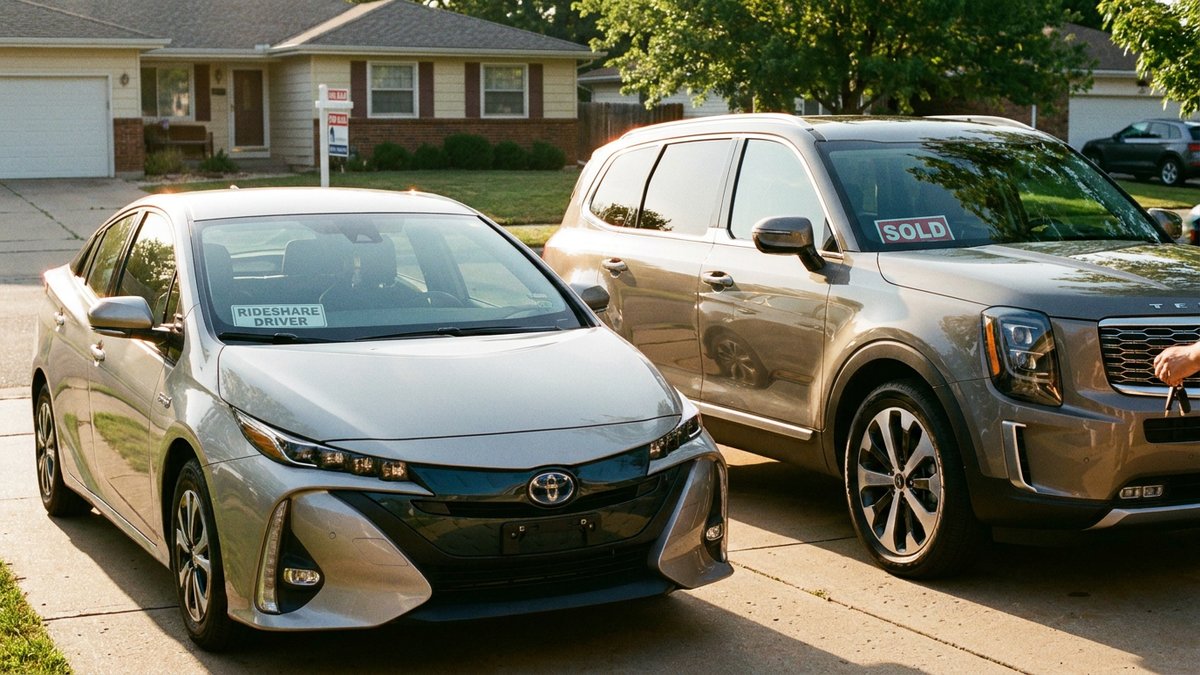
I started renting for Uber in early 2023. By late 2024 I owned my first car outright, and by mid-2025 I had two cars I was renting out to other drivers on RideshareRenter while still driving my third one myself. The path wasn't dramatic. It was a series of small, boring financial moves that compounded.
If you're tired of handing $1,400 a month to a rental and thinking "shouldn't this go toward something I own," here's how the math actually plays out.
Renting is expensive but flexible. You pay roughly $290–$485 a week, and in exchange you carry zero responsibility for repairs, depreciation, tags, registration, inspections, or the inevitable transmission failure at 142,000 miles.
Owning is cheap per mile but front-loaded with risk. You need money for the down payment, a buffer for maintenance, and the discipline to keep driving when the car needs $2,300 of unexpected work.
The crossover point — when owning beats renting on pure dollars — usually sits between month 9 and month 14, depending on the car you buy and how many hours you drive. Below that, you're losing money you'd have kept renting. Above it, the gap widens fast.
The single biggest mistake I see new drivers make is trying to buy a car in their first three months on the road. They don't have an honest read on their own earnings yet, they don't know which neighborhoods they're actually willing to drive in at 2 am, and they don't have a savings cushion if the gig disappoints.
Drive rented from RideshareRenter for at least 90 days. Use that time to:
If you can't save 30% of your driving income, owning is going to be more painful than renting, not less. Don't skip this step.
The math on which car to own is different from the math on which to rent. When you rent, you're paying weekly so depreciation and resale don't really matter to you. When you own, depreciation is most of your real cost.
Cars that hold up well for rideshare ownership in 2026:
| Vehicle | Used Price Range (3–5 yrs old) | Real Maint Cost/Yr | Why It Works |
|---|---|---|---|
| Toyota Camry Hybrid | $19,500–$24,000 | $850 | 48 mpg, parts cheap, infinite resale market |
| Toyota Prius | $17,500–$22,000 | $700 | Lowest fuel cost, holds value forever |
| Honda Accord Hybrid | $20,000–$25,500 | $900 | Roomier than Camry, great reliability |
| Toyota Sienna Hybrid (XL) | $34,000–$42,000 | $1,200 | XL eligible, sliding doors, best 7-seat ROI |
| Hyundai Sonata Hybrid | $17,000–$21,000 | $1,000 | Cheap entry point, watch the older transmissions |
Avoid: BMWs, Audis, anything German. Maintenance kills the math. Tesla Model 3s look great on paper but supercharging costs and tire wear at rideshare mileage erode the savings vs. a Camry Hybrid; only do it if you have free home charging.
Here's a real number set. Buying a 2022 Camry Hybrid for $22,400 in mid-2025:
Monthly cost of owning and driving: $1,046
Comparison to renting the same kind of car: - $315/week rental × 4.33 weeks: $1,365/month - Gas (same): $355/month - No insurance separately; included in rental - Monthly cost of renting: $1,720
Savings by owning: $674/month, or $8,088/year.
That gap is what funds the next car. But — and this is the part the rental-bashing influencers don't say — owning carries downside renting doesn't:
This is why month 6–9 is for math, not for signing. Run your real expenses against a realistic monthly purchase scenario for at least 90 days before you commit.
Once you buy, change your operating mindset. You're not just driving for income now — you're running a tiny business with one asset. The most important habit is the maintenance reserve account.
I keep $1,500 minimum sitting in a savings account labeled "car." Every time I do an oil change ($65) or replace tires ($720) or surprise brake job ($380), it comes out of that account. Every month I refill it back to $1,500. The day I learned to do this is the day owning stopped feeling stressful.
In month 9–14, while you're driving the car you own:
This is where ownership stops being just "I drive my own car" and becomes "I have a small fleet."
If you've consistently saved $400+ a month over and above your loan and maintenance reserve, by month 14 you have $5,600+ in pure savings. That's a down payment on a second vehicle — which you don't drive yourself. You list it on RideshareRenter.
The owner math, conservatively:
What you make listing that car on RideshareRenter as an XL-eligible rental: $1,400–$2,100/month after the platform's owner fee, depending on occupancy. Net to you: $544–$1,244/month with zero hours of your own time.
Stack that with the savings from owning your own driving car, and you're looking at $1,200–$1,900 a month of net cashflow that didn't exist when you were renting. That's the compounding I mentioned at the top.
Three failure modes I've seen:
Should I lease instead of buy? For rideshare, generally no. Lease mileage caps are 12,000–15,000 a year. A full-time rideshare driver does 35,000–55,000 a year. You'll pay massive overage fees.
What about buying a brand-new car with manufacturer financing at 1.9%? The interest rate is great but a new car's first-year depreciation (often 20–30%) wipes out the interest savings unless you keep the car 6+ years. Used 3-year-old hybrids in good condition are the math winner.
Do I need an LLC? Talk to a real accountant about this — it depends on your state and total income. For just one car you drive yourself, usually a Schedule C is fine. Once you have a second car listed on RideshareRenter, an LLC often makes sense for liability separation.
What about EVs? EV ownership math can work in markets with cheap home charging and EV-friendly rideshare incentives (Uber Pro EV bonuses). It doesn't work yet in apartment-living markets where you'd be supercharging at $0.42/kWh.
How much should I have saved before buying my own rideshare car? Minimum: down payment + 3 months of total ownership costs + $2,000 maintenance buffer. For a $20k Camry Hybrid that means roughly $4,500 + $3,200 + $2,000 = $9,700.
Should I keep renting while I'm waiting for the right car to buy? Yes. Idle time costs you income. Keep renting from RideshareRenter on whatever schedule you've been driving, and treat the search for your buy as a side project, not an urgency.
The path from renting your rideshare car to owning two of them isn't an investment scheme. It's a discipline scheme — save aggressively while renting, buy the right used hybrid, build a maintenance reserve, then let savings compound into a second listing. 18 months is a realistic timeline. Six months isn't.
For drivers: Test-drive your own ownership theory while renting on RideshareRenter — drive different models, log real costs, build the savings. Find Rentals →
For vehicle owners (current or future): Once you've got your own car squared away, list a second one on RideshareRenter and start the income compounding. Owners typically net $544–$1,244 a month per listed vehicle after platform fees. List a Vehicle →




Comments