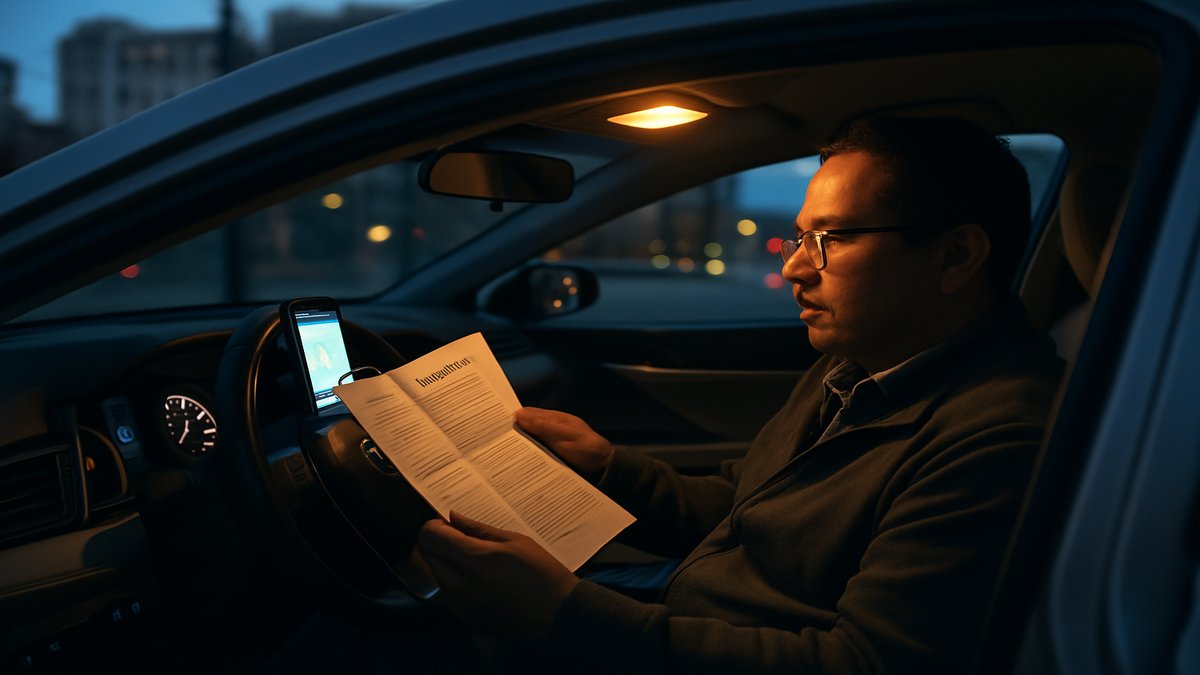
I rented my first car for Uber back in 2023 and the insurance situation confused the hell out of me. The listing said "insurance included." Cool. Then I got into a fender bender three weeks in and learned that "included" is doing a lot of heavy lifting in that sentence.
If you're about to rent a car to drive for Uber, Lyft, DoorDash, or all three, you need to actually understand what you're covered for and what gaps will quietly drain your wallet. Here's the version nobody tells you upfront.
Driving a rented car for rideshare means you're sitting under three different insurance buckets, and they only cover you during certain moments of your shift. Miss the overlap and you're paying out of pocket.
Layer 1: The vehicle owner's commercial rideshare policy. This is what the owner has on the car as part of listing it. On RideshareRenter, the owner carries the commercial coverage that lets the car be used for rideshare work. That's the foundation.
Layer 2: Uber or Lyft's own rideshare insurance. The rideshare apps cover you in chunks based on your driver status. Offline: nothing. App on, no ride accepted (Period 1): liability only, usually $50,000 per person, $100,000 per accident, $25,000 property damage. Period 2 and 3 (en route to passenger or with passenger): $1,000,000 liability plus contingent comp and collision if you have your own.
Layer 3: Your personal coverage gap. This is where drivers get hit. Period 1 has weak liability coverage, and if you crash on the way to a ping with no passenger yet, the deductible can be punishing.
When you rent a car for Uber through RideshareRenter, the owner's listing comes with commercial rideshare insurance that satisfies what Uber and Lyft require to drive their car for ride requests. That's the green light to start working.
It does not mean every dollar of damage in every scenario is covered. Read the listing.
Specifically, watch for:
Uber says they offer $1,000,000 in liability coverage during Period 2 and 3. True. Drivers hear that and assume they're untouchable. They're not.
What Uber's policy actually does during an accident with a passenger in the car is pay out for damage you do to other people and other vehicles. The damage to the car you're driving is a different conversation. Uber has contingent comprehensive and collision, which kicks in only if the driver already carries comp and collision on their own personal policy.
On a rented car, you don't have personal comp and collision on that vehicle. So during a Period 3 crash, the rental owner's commercial policy and its deductible become the relevant document. The Uber $1M is not bailing out the windshield.
I learned this in Phoenix in 2024. Backed into a pole at a hotel pickup. No passenger damage, no third party. Just me, the back bumper, and a $1,400 bill that came out of my deductible. Nobody was happy.
The most exposed window is Period 1. App on, no ride accepted yet. Uber and Lyft's liability drops to bare-state-minimum numbers. That $50K/$100K is not enough if you rear-end somebody's new Lexus on the way to a hot zone.
Some drivers I know carry a separate rideshare endorsement on a personal auto policy specifically to cover Period 1, even though they don't own the car they drive. That feels backwards, and it is, but in California and Texas the math sometimes works because Period 1 is when most fender benders happen — drivers are scanning the app, checking surge maps, half-distracted.
The cleaner option: turn the app off when you're not actively driver-ready. Don't sit at a red light with the app on between shifts. That's an insurance lottery ticket nobody wants to win.
| Scenario | Who pays | Your exposure |
|---|---|---|
| App off, personal errand (if allowed) | Owner's personal coverage on car, if any | Possibly full damage — check listing |
| Period 1: app on, no ride accepted | Uber/Lyft basic liability | High — weak liability limits, deductible applies |
| Period 2: en route to passenger | Uber/Lyft $1M liability | Deductible on the rental ($1K–$2.5K) |
| Period 3: passenger in car | Uber/Lyft $1M liability + contingent | Deductible on the rental ($1K–$2.5K) |
| Theft of rental | Owner's comp coverage | Deductible |
| Single-car at-fault accident, no passenger | Owner's collision coverage | Deductible |
| Tire blowout, curb damage | Driver (usually) | Full cost |
RideshareRenter lets you message owners directly before you commit to a rental. Use that. Skipping this step is how drivers end up with surprise bills.
Things worth asking:
The good owners answer in detail because they've been around the block. The owners who give you one-word answers or ghost you for two days are showing you who they are. Pick someone else.
I have done this twice. Once it cost me a deductible. Once it cost me nothing because I followed the steps. Here's the order:
That last one saved me a deductible in a Houston intersection mess where the other driver ran a yellow and I assumed I was at fault for being in the box. I wasn't. The police report agreed.
Sort of. You can buy a non-owner rideshare policy that fills the Period 1 gap and gives you additional liability coverage. State Farm, Allstate, and a couple of regional carriers offer this. Costs run $30 to $90 a month depending on your state and driving record. Worth it if you drive 40+ hours a week.
This is the nightmare scenario, and it happens when there's a dispute about which Period you were in. Document everything. The Uber/Lyft trip data is the determining factor. If you have GPS records, app screenshots, and the police report, you can usually get one of the two policies to take responsibility. Slow process. Sometimes weeks.
Usually no. Personal auto policies almost universally exclude commercial use, including rideshare. The exception is if you've added a rideshare endorsement, and even then, the coverage on a vehicle you don't own gets weird. Don't rely on it.
Not covered by anything on the rental. Renter's insurance or homeowner's insurance on your phone, laptop, etc., is what protects those. Don't leave anything in the rental overnight.
Yes. Owners listing in Atlanta, Los Angeles, Miami, and Chicago carry higher commercial premiums, and that gets baked into rental rates. A $300/week rental in Tulsa is a $475/week rental for the same car in LA. Insurance is most of the gap.
Yes, as long as the owner's commercial policy covers rideshare in general, not one specific platform. Confirm in the listing. Most RideshareRenter owners write their policies to cover all rideshare and delivery platforms because that maximizes earnings for the drivers and the rental.
Rental insurance for Uber driving is not a scam, but it's also not the all-inclusive blanket the word "included" implies. You're covered for the big stuff — third-party liability, catastrophic loss — but you'll eat deductibles for fender benders and pay out of pocket for tires and curb rash. Build that into your weekly cost expectations.
The drivers who do best know exactly which Period they're in at all times, keep the app off when they're not working, and read the listing before they book.
For drivers: Browse RideshareRenter listings in your city and message owners directly about their deductible and insurance details before you book. The best rentals come from owners who answer questions fast and don't dodge the details.
For vehicle owners: If you've got a car sitting in the driveway and you're tired of it depreciating for nothing, list it on RideshareRenter. Owners with clear, transparent insurance policies and quick communication book the fastest and keep cars rented year-round.




Comments