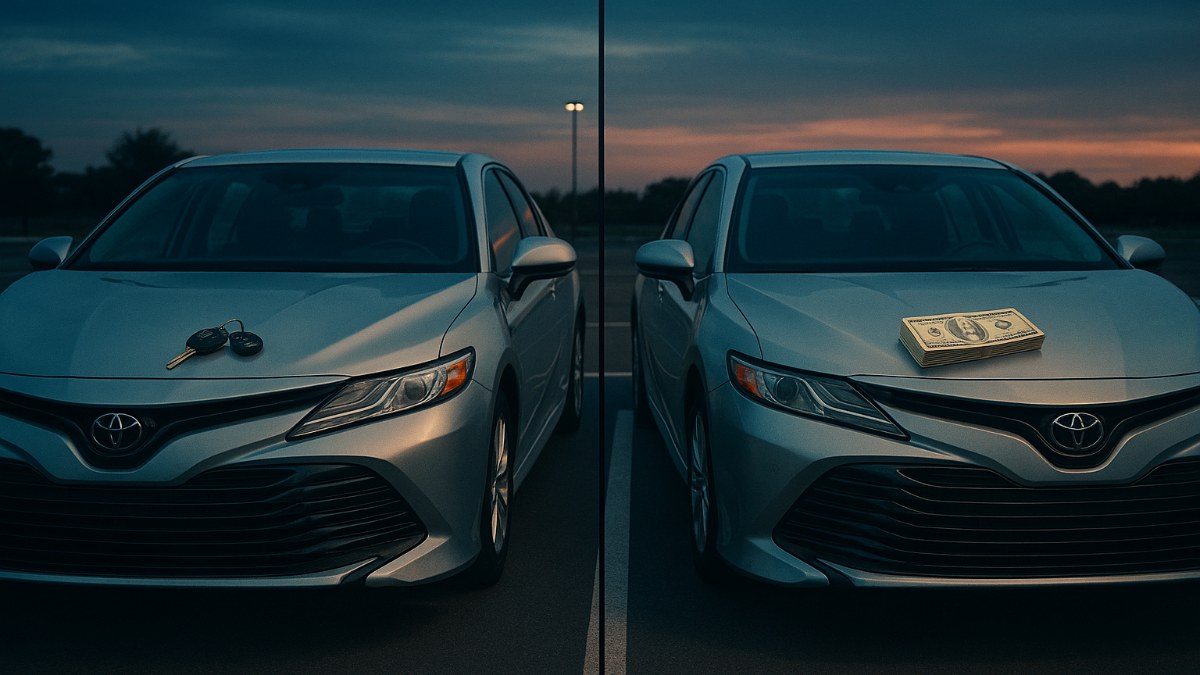
Every few months a driver asks me some version of the same question: "I've been renting for a year. Should I just buy?" My answer in 2026 is usually "do the math, don't do the vibe," because the math has shifted again — used cars are still expensive, insurance for rideshare keeps climbing, and the rental rate has flattened.
Here's the unedited cost comparison I run with drivers. Numbers are 2026, sedan-class, full-time rideshare (50–55 hours a week).
Start with the simple side. You rent a 2022 Toyota Camry hybrid on RideshareRenter at $285 a week. Insurance and maintenance are baked in. You buy gas. That's it.
| Line item | Annual cost |
|---|---|
| Weekly rent ($285 × 52) | $14,820 |
| Refundable deposit (returned at end) | $0 net |
| Fuel (60,000 mi / 47 mpg hybrid × $3.85/gal) | $4,915 |
| Tolls, parking, washes | $900 |
| Total out-of-pocket, year 1 | $20,635 |
If you skip 2 weeks (vacation, sick), that drops to $20,065. Renting is highly predictable: very few surprise costs, and if the car breaks, the owner deals with it.
Now the buy side. You finance a 2022 Camry hybrid with 35,000 miles. Used-car prices stabilized but didn't drop — expect to pay around $24,500 with taxes and fees. You put $4,000 down, finance the rest at 9.4% for 60 months. The monthly payment is roughly $430.
| Line item | Annual cost |
|---|---|
| Down payment (year 1 only) | $4,000 |
| Loan payments ($430 × 12) | $5,160 |
| Rideshare-endorsed insurance (avg of high-volume markets) | $3,400 |
| Registration, plates, emissions | $280 |
| Fuel (same as rented car) | $4,915 |
| Tolls, parking, washes | $900 |
| Oil changes (every 5,000 mi) | $360 |
| 2 sets of tires (60,000 miles eats them) | $1,200 |
| Brake pads + rotors | $650 |
| Repair reserve (timing belt scare, AC, sensors) | $1,400 |
| Gap insurance | $320 |
| Total out-of-pocket, year 1 | $22,585 |
You're looking at $1,950 more in year one to own. That feels backwards if you've never run the numbers — most drivers assume buying is cheaper. It usually isn't, in year one.
Year one is rent's best year. After that, the math starts to flip — but slower than you'd think.
| Rent | Buy | |
|---|---|---|
| Year 1 | $20,635 | $22,585 |
| Year 2 | $20,635 | $17,540 (no down payment, more repairs) |
| Year 3 | $20,635 | $18,820 (transmission service, more tires) |
| Year 4 | $20,635 | $19,400 |
| Year 5 | $20,635 | $19,950 (loan paid off mid-year) |
| 5-year total | $103,175 | $98,295 |
Buying wins by about $4,880 over five years — assuming everything goes right. The "everything goes right" caveat is doing serious work in that sentence. One transmission rebuild ($3,800), one totaled car you still owe on, or four months of being too sick to drive while the payment keeps coming, and the buy side is back underwater.
Depreciation. A 2022 Camry hybrid bought in 2026 for $24,500 will probably be worth $9,000–$11,000 in 2031 with rideshare mileage on it. That's $13,500–$15,500 of depreciation eaten by your earnings.
On the rent side, depreciation is the owner's problem. You're paying for the use of the asset and walking away at the end with nothing — but also with no $15,000 hole.
The mirror image of that is the buy-side upside: at the end of 5 years, you own something. Even at $9,000 of resale, that's $9,000 you don't have if you've been renting. Pull that out of the buy-side total above and the gap widens to about $13,880 in favor of buying.
So if you're a buyer in 2026, you're effectively betting:
If any of those break, renting wins on the math.
Most factory leases prohibit rideshare use. The ones that allow it (a few EV programs, some manufacturer rideshare leases) usually come with mileage caps under 12,000 miles per year — which is laughable for a full-time driver doing 60,000. Skip leasing as a category unless the contract specifically permits commercial use.
Is renting through RideshareRenter cheaper than HyreCar was?
On weekly rate alone, comparable. The bigger difference is RideshareRenter is a marketplace — you negotiate directly with owners and rates vary. HyreCar was centrally priced.
How many miles is too many on a used Uber car?
For a sedan, I'd be nervous above 110,000 miles. For a Toyota or Honda hybrid, that ceiling stretches to 140,000. Always look at the maintenance records, not just the odometer.
What's the break-even point — when does buying beat renting?
Based on the numbers above, between month 13 and month 18 for a full-time driver. Below 35 hours a week, the break-even pushes past year 3 and renting usually wins permanently.
Can I rent on RideshareRenter to "try before I buy"?
That's actually a reasonable use case. Six months on a rental is enough to know whether you like rideshare full-time. Then you've got a real basis for the buy decision.
What if I buy a car and rideshare doesn't work out?
You either sell at a loss, switch the car to personal use (now you have a car payment instead of a job), or list it on RideshareRenter as an owner. The flexibility cost of buying is real and almost no driver thinks about it before the purchase.
Buying a car for Uber saves about $1,000 a year, on average, if everything goes right. Renting costs more on paper but transfers most of the risk to someone else. Pick based on how stable your rideshare income is, how much cash you have, and how much risk you can absorb — not based on which option "feels" cheaper.
For drivers: Compare current weekly rates by city on RideshareRenter.com.
For vehicle owners: If you already own a car that fits the Uber/Lyft model year rules, list it on RideshareRenter and let someone else's break-even math work for you.




Comments