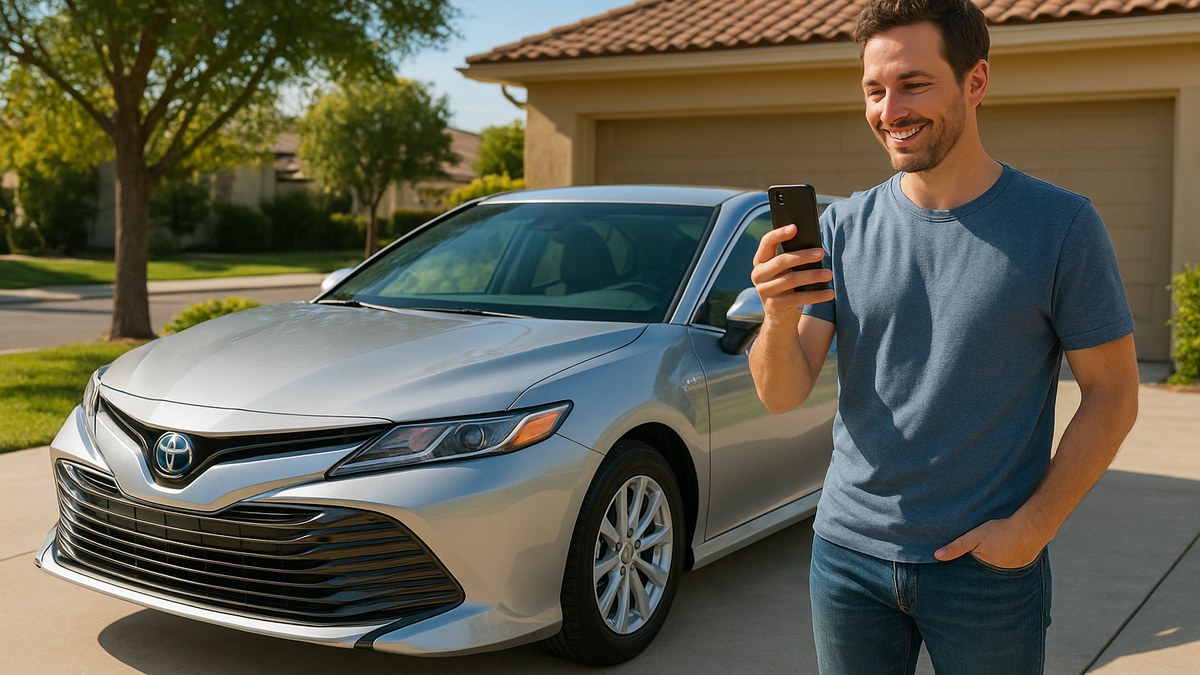
You listed your car three weeks ago. Maybe four. Page views are climbing but the inbox stays empty. Or worse — you got two messages, both ghosted you after the first reply. I've been on both sides of RideshareRenter (rented other people's cars before listing my own 2018 Camry hybrid), and the pattern is almost always the same. The listing looks fine to you. To a gig driver scrolling on their phone at 11pm trying to lock something in for tomorrow, it's missing the three things that close the deal.
Here's what's actually killing your inquiry rate, in rough order of how much each one costs you.
Driver brain is different from buyer brain. A buyer wants to fall in love with the car. A gig driver wants to know it'll start tomorrow, pass an Uber inspection, and not eat 40% of the week's earnings in gas.
If your first photo is a glamour shot of the front grille against a sunset, swap it. The first photo should be the front three-quarter angle in flat daylight, ideally in a parking lot or driveway — not on a curving road, not from below. That's the angle Uber and Lyft inspection photos use, and it signals "rideshare-ready" in half a second.
Then in the gallery:
Six photos beats twelve. Twelve mediocre photos signals "I'm trying to hide something."
This is the single fastest fix. Drivers filter mentally for "can I run Uber Comfort?" or "can I do UberXL?" If your listing just says "great for rideshare," it lands in everyone's mental "maybe" pile and gets skipped.
Write it out. Year, make, model, doors, seatbelts. Then list which programs the car qualifies for in major US cities. A 2020 Toyota Sienna can run UberX, Uber Comfort (in some markets), UberXL, Uber Pet, Lyft Standard, Lyft XL, and Uber Eats. A 2017 Corolla LE runs UberX, Lyft Standard, and delivery — that's it. Drivers know the difference. Saying it out loud doubles the number of qualified inquiries.
Most owners price by feel and end up in the worst zone — too high to be a deal, too low to look serious. The market on RideshareRenter for 2026 is tight enough that drivers know what fair is within $5 a day.
| Vehicle Type | Daily Rate That Books | Weekly Rate That Books | What Drivers Skip |
|---|---|---|---|
| Compact (Corolla, Civic, Sentra) | $38-$48 | $235-$295 | Anything over $55/day |
| Hybrid sedan (Camry HV, Accord HV, Prius) | $48-$62 | $295-$385 | Anything over $70/day for non-Tesla hybrid |
| Midsize SUV (RAV4, CR-V, Rogue) | $55-$68 | $345-$420 | Over $75/day or unlimited-miles capped at 800 |
| 3-row SUV (Sienna, Pacifica, Highlander) | $68-$88 | $425-$540 | Over $95/day without UberXL eligibility called out |
| Tesla Model 3 / Y | $78-$98 | $485-$615 | Over $105/day without Supercharger access included |
Suspiciously cheap is the other failure mode. A 2021 Camry hybrid at $32/day flags fraud or salvage title in driver brain. Better to be at $52 and rent than $32 and sit.
A full-time Uber driver does 1,200-1,800 miles a week. If your listing buries the mileage cap three paragraphs down, or worse — doesn't mention it — you're going to get tire-kickers and ghosts.
Lead with it. "Unlimited miles in [your state]" if that's true. Or "1,500 miles/week included, $0.18 per mile over." Drivers do this math in their heads as they read. The ones who do 800 miles a week don't care. The ones doing 1,500+ will skip you instantly if they can't tell, because a tight cap means a $200 surprise on Sunday.
I've seen listings that just say "fully insured." That's worse than saying nothing. Drivers read that as "this owner doesn't know what coverage I'm renting under."
Say what RideshareRenter actually provides for your listing — commercial rideshare coverage during paid periods on the app, the deductible amount, and what's required from the driver (personal liability for off-app driving, etc.). If you don't know your own listing's insurance terms cold, open the RideshareRenter help docs and learn them. Drivers will ask. Confident, specific answers close the rental. "I think so" loses them.
Gig drivers operate in hours, not days. If a driver messages you at 8pm trying to start tomorrow, and you reply at 11am the next day, they've already booked someone else. RideshareRenter's owner dashboard shows your average response time on your public profile.
Owners with sub-1-hour response times convert inquiries to rentals roughly twice as often as owners over 6 hours. You don't need to be glued to the app — you need push notifications on, and a 30-second "yes, available, here's pickup info" template you can fire back at any time.
"Pristine, well-maintained, spacious interior, immaculate condition" — drivers tune that out by the third word. They want operational facts.
Try this template instead:
Five sentences. Done. Drivers will read all of it. They will not read 400 words about how you've cared for the car since 2018.
Cold listings without reviews convert maybe 1 in 30 inquiries. Listings with three or more 5-star rental reviews convert closer to 1 in 8. That first rental is worth taking at a $10/day discount to lock in. Be picky on driver vetting, be generous on price for week one, and turn that first rental into a review you can show off.
How long should it take to get my first inquiry on RideshareRenter?
In a major US market with photos and pricing dialed in, most new listings get their first qualified inquiry within 3-5 days. If you're past 10 days with no messages, the listing is the problem, not the platform. Re-shoot the lead photo and re-check the price against the table above.
Should I offer a discount for the first week to attract a driver?
Yes. 10-15% off your standard weekly rate, capped to 7 days, in exchange for an honest review. Frame it in the listing as an introductory rate — drivers respect that more than a permanently low price that signals desperation.
Does it matter if my car is older than 2014?
A lot. Uber's vehicle age cutoff in most US cities is 2014-2016 depending on the market, and Lyft Comfort needs 2017+. If your car is 2013 or older, your audience is delivery-only drivers (DoorDash, Uber Eats, Instacart, Spark). Say that explicitly in the listing. Trying to hide it just costs you inquiries that won't convert.
What's the ideal photo lighting and time of day?
Late morning or mid-afternoon on an overcast day is best — flat light, no harsh shadows on the paint, no sun glare on glass. Avoid golden hour shots that make the car look orange. Drivers want to see the actual color and condition.
Should I offer pickup or require drivers to come to me?
Pickup at a fixed location (your home or a nearby lot) is fine and standard. Offering to meet a driver near a transit hub adds maybe 15-20% to your inquiry rate in cities where many gig drivers don't own a second car. It's not required, but it's an easy edge.
How much does the listing description length matter for SEO inside RideshareRenter?
Less than you'd think. RideshareRenter's internal search favors recency, price, response time, and review count over description length. A tight 150-word listing with all the operational facts will outrank a 600-word filler description.
For vehicle owners: Pull up your current listing right now. Score yourself against the seven items above. Update your RideshareRenter listing with the fixes from this guide.
For drivers reading this: Knowing what good listings look like is also how you spot bad ones. Browse RideshareRenter rentals in your city and use this list in reverse.




Comments