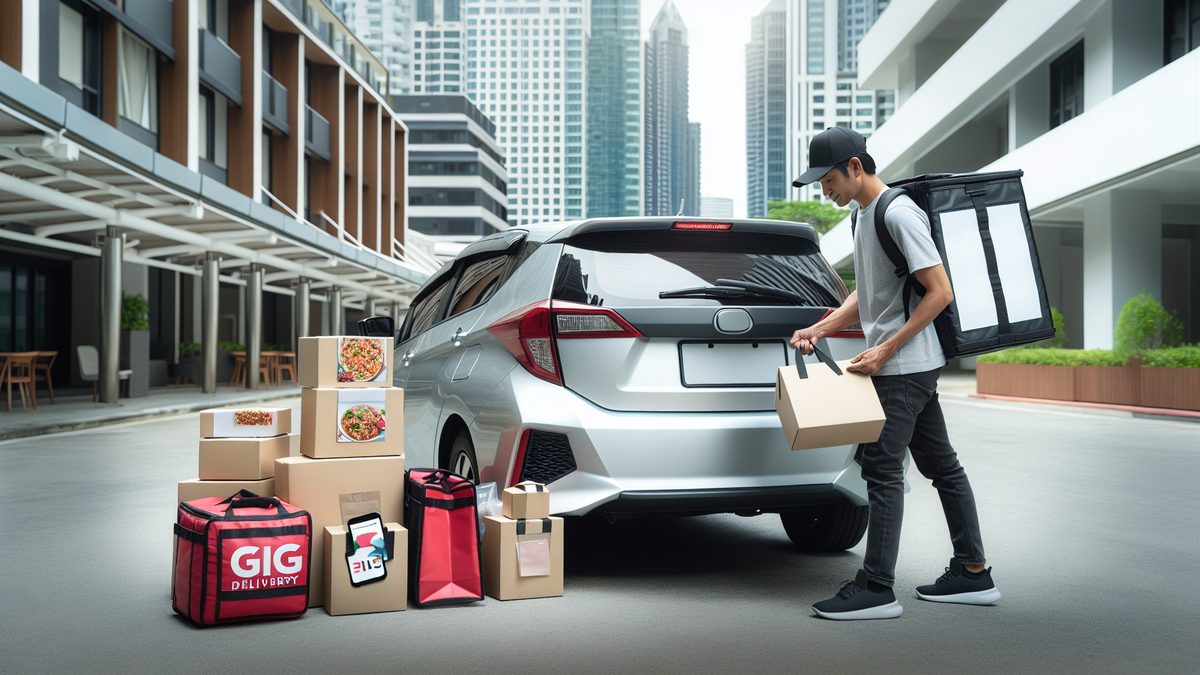
You don't need to drive for Uber or Lyft to benefit from a rideshare rental. If you're running deliveries for DoorDash, Instacart, Uber Eats, or Amazon Flex, renting a car through RideshareRenter can get you on the road fast — sometimes within 24 hours — without the headache of a long-term lease or a $3,000 down payment at a dealership.
I spent two years delivering food and groceries before I ever picked up a single rideshare passenger. And honestly? The rental math works just as well for delivery gigs. Here's what you actually need to know.
Let's be real. Buying a car right now is expensive. The average used car payment in 2026 sits around $525/month before you factor in insurance, maintenance, and the inevitable surprise repair that always hits at the worst time.
Renting through RideshareRenter typically runs $200–$350 per week depending on the vehicle and your city. That sounds like more money on paper — about $800–$1,400/month — but here's what most people miss:
For someone who needs a car now to start earning this week, that tradeoff makes sense. Especially if your credit score isn't exactly stellar.
This is the first question everyone asks, and the answer depends on the platform.
| Platform | Rental Cars Allowed? | Notes |
|---|---|---|
| DoorDash | Yes | No vehicle restrictions for most deliveries |
| Uber Eats | Yes | Same vehicle requirements as Uber rideshare |
| Instacart | Yes | You need reliable transport; they don't check registration |
| Amazon Flex | Yes | Must be midsize or larger for most blocks |
| Grubhub | Yes | No specific vehicle requirements |
| Spark (Walmart) | Yes | Larger vehicle preferred for grocery orders |
The good news: delivery apps are generally less picky about vehicles than rideshare. DoorDash doesn't care if you're driving a 2015 Corolla or a 2023 RAV4. They just need you to show up with the food.
That said, if you're doing Instacart or Amazon Flex, a bigger car helps. You're hauling groceries and packages, not people. An SUV or midsize sedan with decent trunk space will let you take larger batches and earn more per trip.
I'm not going to feed you some fantasy about making $2,000 a week delivering burritos. Here's what the numbers actually look like in a mid-size market:
DoorDash (full-time, 40-50 hours/week): - Gross earnings: $800–$1,200/week - Rental cost: $250/week (economy sedan on RideshareRenter) - Gas: $60–$90/week - Net take-home: $460–$860/week
Instacart (full-time, 35-45 hours/week): - Gross earnings: $700–$1,100/week - Rental cost: $275/week (midsize SUV on RideshareRenter) - Gas: $70–$100/week - Net take-home: $355–$725/week
Multi-apping (DoorDash + Uber Eats, 45-55 hours/week): - Gross earnings: $1,000–$1,500/week - Rental cost: $250/week - Gas: $80–$110/week - Net take-home: $660–$1,140/week
These numbers aren't glamorous. But they're honest. And for somebody who needs income right now — maybe between jobs, maybe building toward something else — clearing $500–$1,000 a week with no car payment and no credit check is a real option.
Not every car on RideshareRenter is great for delivery gigs. Here's what to look for:
Fuel efficiency matters most. You're driving 100–200 miles per day doing deliveries. A car that gets 35 mpg versus 22 mpg saves you $30–$50 per week in gas. That adds up to $120–$200/month straight into your pocket. Look for Toyota Corollas, Honda Civics, or Hyundai Elantras.
Trunk space is the second priority. If you're doing any grocery delivery (Instacart, Spark, Amazon Fresh), you need room. A sedan trunk works for DoorDash. Instacart batches with 50+ items? You want a hatchback or small SUV.
Skip the luxury cars. That BMW 3 Series listing might look tempting, but premium gas and higher rental prices will eat your margins alive. This is a business decision, not a status symbol.
Check the mileage policy. Some RideshareRenter listings have daily mileage caps. Delivery drivers can easily hit 150+ miles on a busy day. Make sure your rental allows unlimited miles or has a cap high enough to cover your routes.
The signup process is straightforward:
Create your driver profile on RideshareRenter. You'll need a valid driver's license, proof of insurance (or you can get it through the platform), and a clean driving record.
Search for vehicles in your city. Filter by price, vehicle type, and availability. Look for listings that specifically mention gig work or delivery-friendly.
Message the vehicle owner. Be upfront about what you're using the car for. Most owners on RideshareRenter are already familiar with gig work and have set their terms accordingly. Ask about mileage limits, maintenance, and what happens if there's a mechanical issue.
Book and pick up. Most rentals can start within 1–3 days. Some owners offer same-day pickup.
Activate your delivery apps. If you haven't already signed up for DoorDash, Instacart, or other platforms, do that while you're waiting for your rental. Approval usually takes 3–7 days.
A few things I wish somebody had told me when I started:
Multi-app from day one. Don't put all your eggs in the DoorDash basket. Run Uber Eats and DoorDash simultaneously. Accept the best-paying order, decline the rest. Your hourly rate jumps 30–40% just from being selective.
Track every mile. Seriously. Every mile you drive for work is a tax deduction at $0.70/mile in 2026. If you're driving 1,000 miles a week, that's $700 in deductions. Over a year, that's $36,400 in deductions that could dramatically lower your tax bill. Use Everlance or Stride — they're free.
Rent the cheapest car that fits your needs. The difference between a $225/week rental and a $300/week rental is $3,900 per year. That's real money. Unless you need the bigger car for Instacart batches, go economy.
Don't deliver during dead hours. Lunch (11am–1pm) and dinner (5pm–9pm) are where the money is. Driving around at 3pm hoping for orders is just burning gas.
If you own a fuel-efficient car that's sitting in your driveway, listing it on RideshareRenter for delivery drivers is a smart move. Here's why:
Delivery drivers tend to put on more miles than rideshare drivers, but the wear and tear is actually lighter. No passengers means no spilled drinks, no seat damage, no complaints. The car just needs to be reliable and clean.
Owners listing economy sedans in major metros are pulling in $900–$1,400/month on RideshareRenter. If your car payment is $400/month, that's pure profit covering your note and then some.
List your vehicle on RideshareRenter today →
Yes. DoorDash doesn't restrict rental vehicles. As long as you have a valid license and an insured car, you're good. RideshareRenter vehicles come with insurance options that cover gig delivery work.
On RideshareRenter, expect to pay $200–$350/week depending on your city and vehicle type. Economy sedans run cheaper; SUVs and larger vehicles cost more but let you take bigger delivery batches.
Standard personal auto insurance usually doesn't cover commercial delivery work. RideshareRenter listings often include commercial insurance or offer it as an add-on for $30–$75/week. Always confirm coverage before you start delivering.
It depends on your market and how many hours you work. If you're grossing $900+/week and your rental is $250/week, you're clearing $500+ after gas. For a no-commitment, no-credit-check way to earn income, it's worth it for many drivers.
Absolutely. Most RideshareRenter vehicles are approved for all major gig platforms. Just let the vehicle owner know you'll be multi-apping so they can set appropriate mileage expectations.
Contact the vehicle owner through RideshareRenter immediately. Most owners have roadside assistance or a backup plan. RideshareRenter's platform also has support to help resolve mechanical issues quickly. You won't be stuck paying for someone else's car problems.
Ready to start earning? Browse delivery-friendly rentals on RideshareRenter →
Own a car you're not using? List it on RideshareRenter and earn $900+/month →




Comments